Homeschooling

Rinoa’s Ostrich Lapbook

November 10, 2010

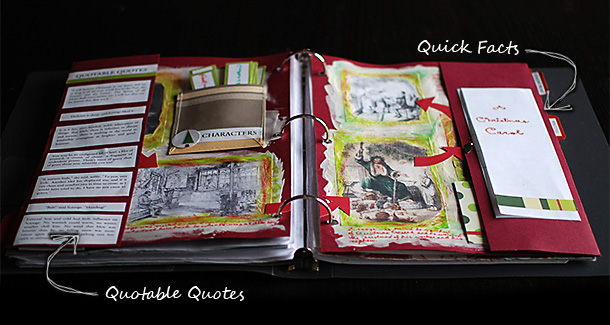
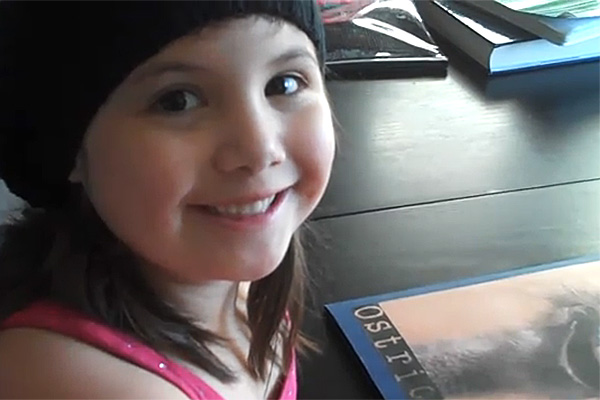
Rinoa is currently learning about animals in science. It is the first part of her three-part life science curriculum this year – with the other two being the human body and plants. Here is a lapbook we did to learn more about ostriches, including a video of her showing the lapbook and talking about ostriches. (With a few modifications, this lapbook project was taken from here.)

{ 5 comments }

I’m sure I’ve mentioned in the past that history has become Rinoa’s favorite subject. Each morning as we start our schoolwork, she would ask me if she has history lessons that day. When she doesn’t (since I alternate history and science), she would plead to have history – much to Mica’s irritated astonishment. (Haha!)

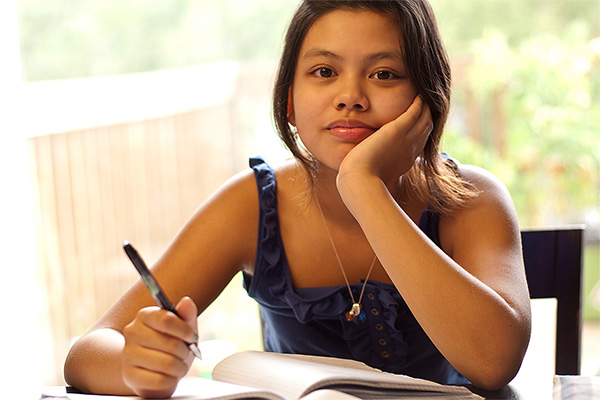
My curriculum is loosely based on the The Well-Trained Mind, and as such, I use the The Story of the World by Susan Wise Bauer to teach Rinoa history. (This is a four-volume series. We are currently using Volume I and studying about Ancient Times.) During class, I read to her a chapter from the book. (Sometimes we read together.) The book, written for grade school children, has an easy-to-read narrative style that introduces historical events and keeps Rinoa constantly engaged on the lesson. As I read to her, I ask her questions to make sure she understands what we’re reading. I also use a large wall map to show her various places and areas as we come across them. Afterwards I give her time to write down a short summary of what we just read and draw a picture to go with her narration. (According to the Well-Trained Mind, “narration is a way to develop the child’s understanding and storytelling skills.”)

Here are a few narration pages that Rinoa made for her lesson on “The Earliest People”:

Nomads by Rinoa Redington (5 years old)

The drawing shows a young nomad catching a lizard to give to her mom to cook for breakfast. The narration is as follows: “Nomads move from place to place to find food. The live in tents or caves. They eat berries, lizards, eggs, honey, and large animals like deer.”

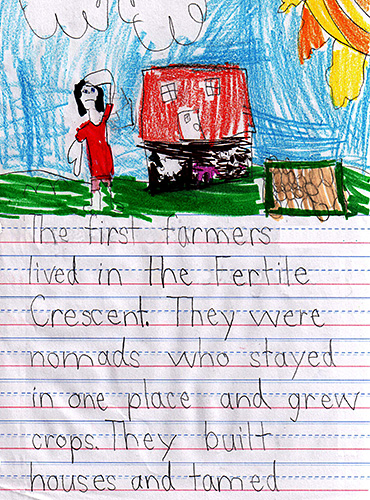
The First Farmers by Rinoa Redington (5 years old)

The drawing shows a farmer hard at work. (He is wiping off his sweat.) He keeps his livestock beside his house (in the middle) and he has a field of crops on the right. The narration is as follows: “The first farmers live in the Fertile Crescent. They were nomads who stayed in one place and grew crops. They built houses and tamed animals like sheep and goats.”

Map Work by Rinoa Redington (5 years old)

When Rinoa is done with her narration page, we do some map work. This one shown here is from the activity book that goes with the Story of the World. (It is bought separately but is a huge time-saver.) Aside from the map work, the activity book includes review questions, sample narrations, coloring pages (which Rinoa love!), and lots of projects.

I supplement the Story of the World with the Usborne Internet-Linked Encyclopedia of World History. The colorful illustrations in the book help Rinoa picture more vividly the lessons that we discuss. Some of the internet resources, especially the ones designed for children, reinforce our studies and keep Rinoa entertained.

Here’s a summary of the books I use for grade school history:

Con mucho amor,

{ 1 comment }

Somewhere I Have Never Traveled

September 28, 2010

Somewhere I Have Never Traveled
e. e. cummings

somewhere I have never traveled, gladly beyond
any experience, your eyes have their silence:
in your most frail gesture are things which enclose me,
or which I cannot touch because they are too near

your slightest look easily will unclose me
though I have closed myself as fingers,
you open always petal by petal myself as Spring opens
(touching skillfully, mysteriously) her first rose

or if your wish be to close me, I and
my life will shut very beautifully, suddenly,
as when the heart of this flower imagines
the snow carefully everywhere descending;

nothing which we are to perceive in this world equals
the power of your intense fragility: whose texture
compels me with the color of its countries,
rendering death and forever with each breathing

(I do not know what it is about you that closes
and opens; only something in me understands
the voice of your eyes is deeper than all roses)
nobody, not even the rain, has such small hands

Part of Mica’s language arts program is reading classic books and poetry. She just got done reading Little Women by Louisa May Alcott. And after that, I gave her the poem above to read, discuss, and memorize.

“Somewhere I Have Never Traveled” is probably my favorite poem ever. It’s just so intense and romantic – makes you fall in love. The first time I encountered the poem was in my freshman English class in college. My professor played us this song from Beauty and the Beast (the TV series) as an introduction. Oh did my heart melt! I got lost in Vincent’s voice (the Beast). While listening to the song in class, I tried to hold back tears. I glanced over at my friend and saw that she was crying! It made me feel better to know I wasn’t the only sentimental one. {Ahh! Wonderful memories!}

Anyways, Mica’s probably too young to appreciate the poem. She finds it too sappy. But I still discussed it with her. Rinoa listened and she got wide-eyed and excited when she understood the metaphor between the poet and a rose in springtime and wintertime.

Analysis of the poem:

First Stanza
{somewhere I have never traveled, gladly beyond any experience}
Cummings starts out by saying he’s gone to a place he’s never been to before and he’s happy.

{your eyes have their silence}
Here we see that he’s using metaphors and allegories in the poem and we get a hint that this “somewhere” he “has never traveled” is not an actual place but more of a state of being. He’s captivated by the gaze (“your eyes”) which takes him to this quiet, peaceful place where everything else seems to vanish.

{in your most frail gesture are things which enclose me, or which I cannot touch because they are too near}
The phrase “frail gestures” gives us a clue that he is talking to a woman. Now “frail” might be construed as negative but it’s actually a compliment, indicating that the woman is tender and delicate. Here we start to understand that the poem is a love story. Her gaze and delicate gestures are so powerful that he feels “enclosed” by them. Her effect on him is so deep within him – it’s at his very core – that it’s “too near to touch”.

Second Stanza
{your slightest look easily will unclose me though I have closed myself as fingers}
He is saying that, before he met her, he has guarded himself from love. Maybe he has been hurt before. But he easily lets his defenses down and bares himself to her even with just a “slight look” from her.

{you open always petal by petal myself as Spring opens, (touching skillfully, mysteriously) her first rose}
He compares himself to a rose and she to nature. Just as a rose bud blooms in the spring, so does the woman have the power to open him up and breathe life into his soul.

Third Stanza
{or if your wish be to close me, I and my life will shut very beautifully, suddenly}
Even though he willingly opens himself up to her, he will just as easily and readily draw himself away from her, if she so wishes.

{as when the heart of this flower imagines the snow carefully everywhere descending}
Again, he compares himself to a rose, now facing its imminent death in the winter – a death that is not tragic but beautiful since the flower will bloom again in the spring. He describes her power over his life and his death – which, like the rose’s and if she so chooses, will not be a tragedy but a glorious celebration just the same as life.

Fourth Stanza
{nothing which we are to perceive in this world equals the power of your intense fragility}
He points out that her feminine ways are so powerful that they go beyond what we know and understand – they transcend the physical world.

{whose texture compels me with the color of its countries}
He compares her traits and characteristics to countries – countries in the woman’s ethereal world, and he is enthralled by them.

{rendering death and forever with each breathing}
Here, he re-emphasizes her power over his life and his death.

Fifth Stanza
{I do not know what it is about you that closes and opens; only something in me understands the voice of your eyes is deeper than all roses}
He can’t quite tell why she has so much power over him, although deep inside him, he understands – and that is enough for him.

{nobody, not even the rain, has such small hands}
So far in the poem, Cummings has been comparing the woman to nature but in this last line, he goes as far as saying that she is more powerful than nature. He is describing the rain as having small hands because a raindrop can go through even the minutest of opening in the soil to get to the seed which it enables to grow and open up. And he is saying that the woman has a much deeper effect than that of rain. (This is actually my favorite line in the poem. So romantic!)

Cummings wrote this poem for his second wife, Anne Barton. His first wife, Elaine Orr, left him for another man, taking their 4-year old daughter with her. The court gave him custody of their daughter for three months in each year but his first wife did not acknowledge this and he didn’t see his daughter until 22 years later. They were only married for two months (although they had an affair for years before that). Hence the “I have closed myself as fingers” in the poem.

Unfortunately, his second marriage did not last long as well. Cummings and Barton separated only after three years. (I know, a tragic ending for such a lovely poem.)

Con mucho amor,

{ 1 comment }